
At CMV Action, we know how important it is that midwives feel confident in understanding and discussing cCMV. At the recent Royal College of Midwives Education and Research Conference 2026, Alice (pictured right), a medical student from Imperial College London, presented her research into midwives knowledge and practice, revealing why more awareness and training are urgently needed.
We spoke to Alice following her presentation to discuss her research.
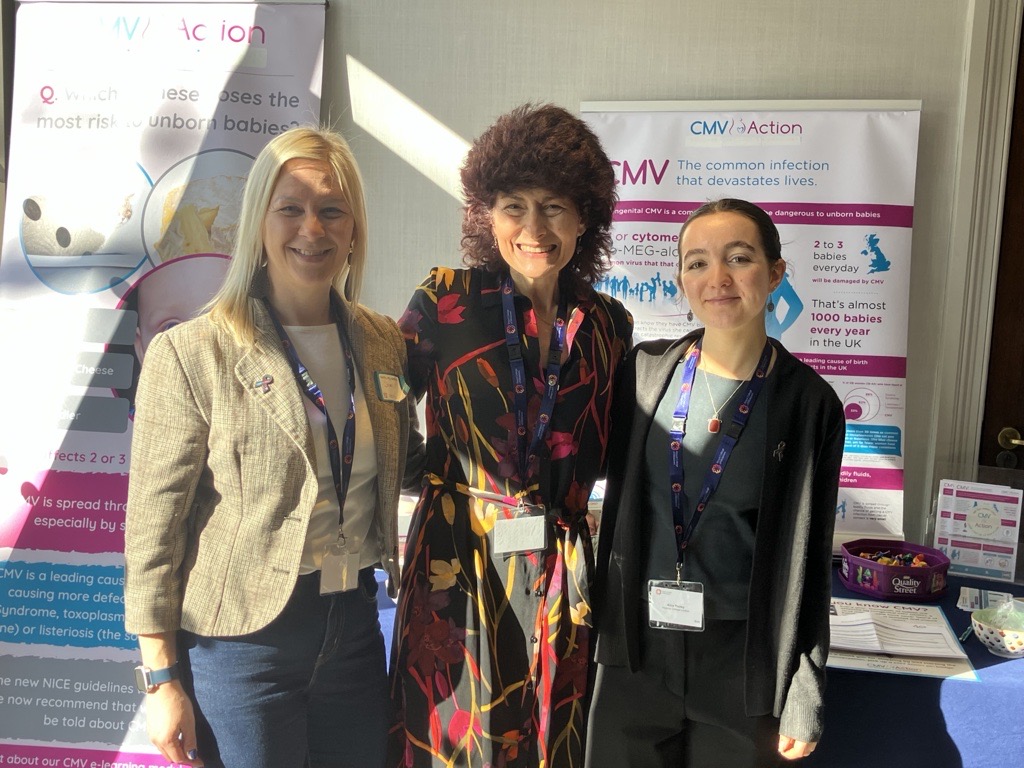
pictured at the RCM Education and Research Conference in March 2026 – from left to right: Sharon Coaker, Sara Barnett, Alice Pooley
Tell us a bit about your background and what led you to explore midwives’ knowledge and practice around cCMV?
I’m a medical student at Imperial College London, currently doing a BSc in Reproductive and Developmental Sciences, and I was seeking meaningful research to get involved with. With the supervision of a consultant in Paediatric Infectious Diseases and an experienced Research Midwife, I decided to explore midwifery awareness of cCMV after learning of the gap in the research.
Clinicians had noticed that this was an area that not all midwives felt confident in managing, and research was needed to quantify this knowledge.
Your survey shows that over 50% of midwives had no training in cCMV. Why do you think awareness and education remain so limited within midwifery practice?
At the moment, midwifery lecturers and educators state that the midwifery curriculum is completely saturated. We don’t know why CMV isn’t emphasised as an important area, perhaps this is due to the lack of routine screening during pregnancy, but also likely due to the lack of acknowledgement that CMV is the most common acquired cause of neurodisability in pregnancy.
Only 11% of respondents felt confident managing suspected CMV cases. What are the real-world consequences of this lack of confidence for pregnant women and babies?
This lack of confidence among midwives may lead to missed opportunities for maternal hygiene education and prevention, diagnoses and referrals to prevent adverse outcomes.
With many midwives not advising on hygiene or recognising key signs, where do you see the biggest missed opportunities to prevent CMV transmission and its impact?
These missed opportunities can arise from not testing for CMV when unwell with a virus, missing signs of cCMV on antenatal imaging scans etc. Knowing that these opportunities for checking for CMV exist is extremely important, especially by ensuring effective antenatal counselling and public health awareness of hygiene prevention.
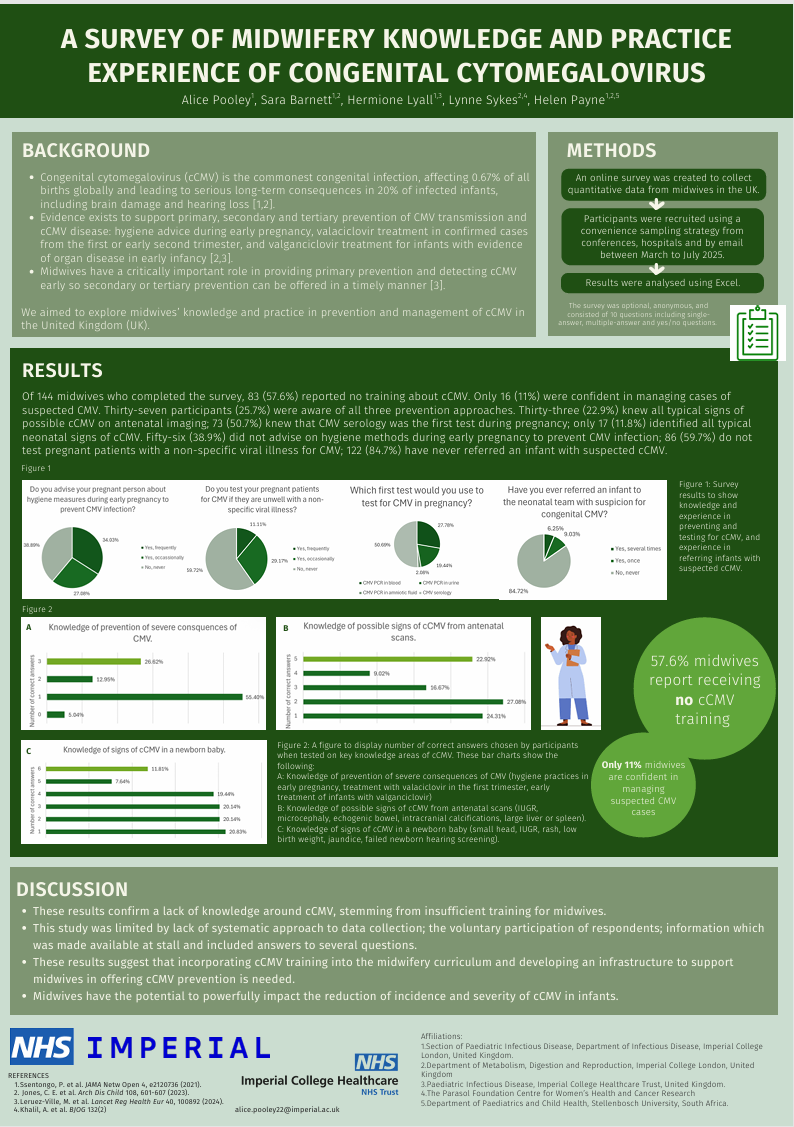
What specific changes would you like to see in midwifery training and professional development to ensure CMV is better understood and routinely addressed?
Incorporation of CMV into the midwifery curriculum, mandatory and refresher training for midwives, embedding CMV prompts onto the midwifery database, distribution of resources to midwives and the creation of a postnatal awareness pathway to ensure hygiene conversations are part of postnatal discharge planning.
These are all important and potentially very effective steps, and it is vital that CMV awareness has a place in the midwifery core curriculum.
How can organisations like CMV Action support midwives to improve awareness, confidence and patient outcomes?
Organisations can share CMV awareness month (June!) where we will be holding stalls in our hospitals to raise professional and public awareness of CMV. Also, to share information, whether at conferences or in newsletters, that provides education and research updates on CMV.
Finally, by providing a safe, supportive, authoritative resource for women and families to which midwives can signpost.